Our environmental vision and targets
Our environmental vision is to work together to protect our planet and ensure a greener, more sustainable future for us all.
- Calculating a comprehensive carbon footprint across scope one, two and all material scope three categories, and implementing a carbon reduction plan for each scope and category
- Reducing energy consumption across our centres and the wider business.
- Reducing the amount of waste that we produce because of our operations.
- Cutting the amount of waste going into landfill, through either recycling or energy from waste.
- Decreasing the volume of single use plastic and packaging used.
- Shortening supply chains, maintaining food provenance and buying locally, where possible.
- Ensuring all products used, including paper and timber, are from a sustainable source.
- Replicating UK best practice supplier enhanced due diligence programme across all Strategic Business Units (SBUs) within the group.
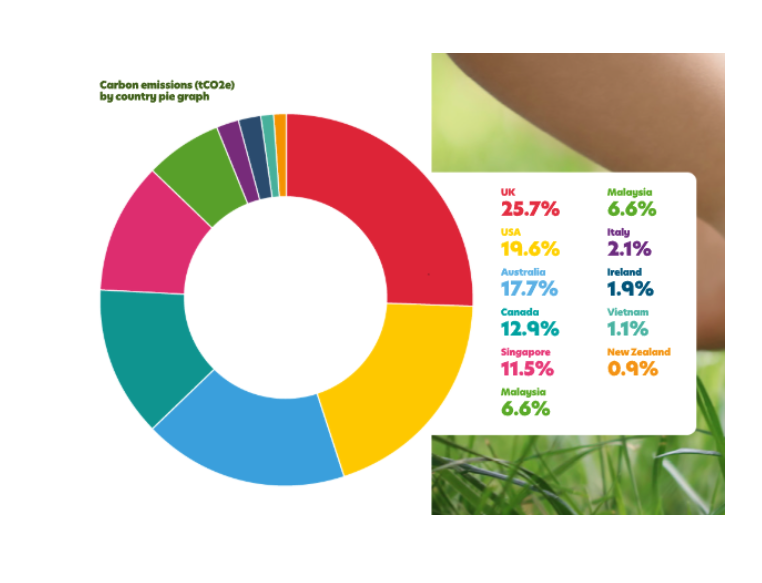
Here is a breakdown of carbon production across the Busy Bees business in 2024.
How are we reducing carbon emissions?

Green tech improvements
- Installing 50 solar farms at centres across the UK, Australia and Singapore, with plans to install more.
- Replacing lighting with energy-efficient LED alternatives across more than 76 centres within the UK, USA, Canada, Ireland and New Zealand.
- Replacing gas and LPG appliances with electric appliances in the UK, Asia and New Zealand
- Installing voltage optimizer in 60 of our UK centres, ensuring equipment uses only the necessary amount of power.
- Installing an innovative system to harvest rainwater at Odyssey Dempsey in Singapore.
- Rolling out 12 more EV and hybrid vehicles to our UK fleet, meaning 85% of the fleet is now low-emission.

Energy efficiencies
- New build UK centre specification seeks to achieve an EPC rating of B or above.
- Regional maintenance teams ensure boiler settings and time clocks are aligned with seasonal changes between summer and winter.
- Using our centre Eco Ambassador and Eco Monitor networks to source ideas for cutting energy use and educate colleagues.
- Expanding our internal communications to drive energy efficiency in centres across our global network, including an internal Knowledge Hub
- Hosting Earth Day Buzz at HQ and HQ Lunchtime Energy Saver Fridays, where we switch off AC and lights during lunchtime
- Taking part in the "Main Streets" programme in the USA, where contractors examine everything from heating and cooling systems to lighting and windows to identify energy savings
How are we reducing waste and single use plastics?
Given our responsibility to care for children, a certain amount of single-use plastic personal protective equipment (PPE) is required. However, we've taken many steps within the business to eliminate single-use plastic, where possible.
For example:
- In 2024, we altered our nappy changing procedure in the UK, with nappies now not needing to be placed in nappy sacks before being disposed of. As a result, we estimate that this will remove 3.7 million nappy bags from circulation each year.
- We removed the requirements for all centre colleagues, bar those serving food, to wear green plastic aprons. This will eliminate around 1.7 million plastic aprons from the UK business annually.
- Efforts are being made to order larger pack sizes for food to reduce packaging requirements, including bigger boxes of cereal.
- Removing the requirement to wear gloves and wear shoe covers in our centres in Ireland, which should remove 800k single use items of PPEOur UK team introduced an industry-leading initiative to support earlier successful toilet training in 2023, including creating engaging activities and encouraging practitioners to identify and communicate the signs of readiness with parents. The toilet training scheme has been built on as part of our Bee Curious curriculum development and was shared with other countries to inspire improvements elsewhere
Global Network
Each country that we operate in is uniquely placed to tackle these priorities, so any initiative that we develop is tailored to consider local opportunities, challenges, and geographies.
We have a global network within Busy Bees to drive forward these priorities. Our Environmental Manager, based in the UK, leads on our environmental programme.
Each country that we operate in has an environmental representative. They are essential links to the local communities that we work in, to ensure the activities we are undertaking remain relevant to the group environmental strategy.
We utilise our UK centre Eco Ambassadors and Eco Monitors as a sounding board to garner views and logistical considerations from centres prior to changes being made. They also bring forward ideas for other improvements across the estate. The change in our approach to using nappy bags and green aprons was inspired by this group.
Our Environmental Management Board meets quarterly to review our progress, to champion the sharing of best practice across the group and to help us work together in line with our strategy and towards our goals.
Our Progress So Far
We are making good progress towards achieving our environmental vision and targets and are always improving how we monitor key items such as:

Energy consumption

Scope 1, 2 and 3 carbon emissions

Waste production

The destination of waste - recycling, energy from waste and waste to landfill

Our fleet, mileage and other travel
As we are a growing business, we have historically tracked our progress on energy consumption, carbon emissions and waste generation against the number of full-time equivalent (FTE) children in our care, to help identify efficiency opportunities across the group. Going forward we will continue to track waste against the FTE and track energy and carbon against the number of centres we operate.
Where practical, we are:
- Continuing to roll out LED lighting across the Group
- Replacing end-of-life appliances and Heating, Ventilation and Air Conditioning (HVAC) with more efficient units, removing oil and LPG heating systems
- Improving energy efficiency through installing better insulation and heat mapping our UK building refurbishments and new builds
- Installing solar panels across our estate
- Procuring renewable energy
- Improving waste recycling facilities across our estate
- Reducing single use plastics within our supply chain